
Fusion Cell reduces scam impacts

Key organisations have become aware of the dangers and consequences of online romance scams, and have worked in a Fusion Cell to do what they can to prevent scams.
National Anti-Scam Centre runs Fusion Cell

Under the auspices of the National Anti-Scam Centre a ‘Fusion Cell’ was convened to bring all of the willing players together to address the emotional and financial harm of romance scams. Fusion cells are time-limited taskforces designed to bring together expertise from government and the private sector to take action to address specific, urgent scam issues.

Participants

The participants in this Fusion Cell were wide ranging including (copied from the final report):

Dating platforms
– eHarmony
– Match Group
– RSVP
Law enforcement  
– Australian Federal Police
– South Australian Police
– Victoria Police
Cryptocurrency
– Swyftx
Government
– AUSTRAC
Digital platforms
– Meta  
Banking
– Australia and New Zealand Banking Group (ANZ)
– Commonwealth Bank of Australia
– Defence Bank
– Macquarie Bank
– National Australia Bank
– Westpac
Victim support
– Consumer Action Law Centre
– IDCARE
– Lifeline Australia
– Tracy Hall Consulting
Academic
– Monash University

I was honored to be asked to give the victim’s perspective to the Inaugural meeting of this Fusion Cell in July 2025.

The Fusion Cell activity is concluded and a final report is now available,

A news report highlighting the report’s outcomes identifies a number of areas including from the news report:

Disruption Outcomes, such as

  • Established new frameworks between banks and digital currency exchanges for sharing suspected scam transactions, stopping the theft before it occurs
  • Sharing of URLs used in romance baiting investment scams with digital currency exchanges and identifying related scam-linked blockchain transactions
  • 377 scam websites, WhatsApp accounts, emails and social media profiles referred for takedown and blocking
  • 1,004 suspected scam transactions and 168 suspect scam cryptocurrency wallet addresses referred for investigation, blocking, and blacklisting
  • Improved on-platform screening and safety by sharing romance scam trends and scammer tactics intelligence with digital platforms

New operational capabilities, such as

  • Developed three frontline response guides for bank staff, law enforcement, and support workers/carers to promote consistent, trauma-informed scam identification, disengagement, and referral
  • Piloted a disengagement referral process for banks, connecting customers still engaged in a romance scam to support organisations. Despite a limited number of referrals, the trial provided valuable insights into operational challenges and strategies for connecting victims with appropriate support services

Support and resource development, such as

  • Developed a pilot Online Relationship Health Check, a 20-question self-assessment tool to help victims identify romance scam risk factors in their relationships
  • Raised awareness and early intervention capabilities in the aged care and disability support sectors through hosting industry forums for management and client-facing staff
  • Delivered an Australian-first romance scam online peer-support group pilot demonstrating the benefits of small group, recovery support led by fellow participants
  • Co-designed, with First Nations community members, a culturally appropriate romance scam awareness poster in the Murrinh-patha language
  • Developed a Language Matters guide to support crime-accurate, trauma-informed and non-stigmatising communication across the ecosystem
  • Created and delivered train-the-trainer resources to uplift support worker staff capability and build confidence in organisations working with at-risk populations”

Online Relationship Health Check

The Online Relationship Health Check is worth checking out. Would it have helped you if it had been available when you were scammed? Just this week I received an email from a woman who said that she did not know about romance scams before she became engaged in one recently.

What enheartens me the most from the work of the Fusion Cell is the active takedown and blocking of URLS, websites, WhatsApp accounts, emails, social media profiles and the investigation, blocking and blacklisting of scam transactions and suspect scam cryptocurrency wallets. These activities come closest to punishing the perpetrators, which mostly cannot be done because of cross country jurisdictional issues.  Stopping them being able to work their scams so easily comes the closest to this.

In my day (2012), none of this was even thought about. We were on our own, mostly, with little support from the many organisations around us. There had been a couple of face-to-face support groups, and I started one in Melbourne in 2015. That group instigated all of the victim advocacy I have done over the years.

For many years the ACCC focussed on educating potential victims through warnings. More recently the National Anti-Scam Center has worked more closely with the banks. To see such a broad group of organisations involved in the various steps of the scam process, coming together and working together, and the outcomes they can achieve though this is heartening.

I commend the Fusion Cell and all its members on their work. I just wish it had been done sooner.

PS: Other Fusion Cells have been done for Job scams and Investment scams. See the reports on their outcomes here.

Other news:
Life Matters Radio Program Icon

Earlier this year I was invited to participate in a radio discussion about how scams have changed over the years. For several years I had pulled away from public speaking – after seven years of victim advocacy I was burnt out. However I could not resist the invitation from Life Matters. See the details on my Media Presence page.

I came away from that radio interview with, as often in my experience talking to the media, frustration that there was not enough time to say all I wanted to say. It became clear to me that there was more I wanted to say. More that encapsulates all I have learnt over the years of writing this blog, my book, and my work with romance scam victims. So…

I’m writing a book

I’m writing a book, for victims… and hope to have this ready in the next month or so.  If anyone would like to be a beta reader – someone who reads the draft and comments on it, please drop me a note in the comments.  Cover reveal will be next…
Fake Friends, Liars and Gumtree scams

A number of interesting articles/pieces came my way recently, especially the piece on the number of fake Facebook accounts being found.  Even when they are removed from Facebook, they are replaced by others…  I also watched a TED talk on how to spot liars, get quoted in an article about Gumtree scams, add a warning about phishing and about scam promises to get your money back.

Fake friends

Recently journalists at the ABC (Australian Broadcasting Commission), our national TV and Radio network, broke a story about hundreds of fake Facebook accounts linked to ‘Texas’, a town of 900 people in Queensland, Australia.

Of the 500 fake accounts they identified, they identified 448 of these as having suspicious signals. Similar anomalous accounts can also be found for our towns of Miami (Queensland), Virginia (Queensland) and Toronto (New South Wales).”  They think it is because scammers are trying to use North American locations, but the Australian city links come up first.  It’s a case of mistaken location: Continue reading Fake Friends, Liars and Gumtree scams

A stolen photo mystery

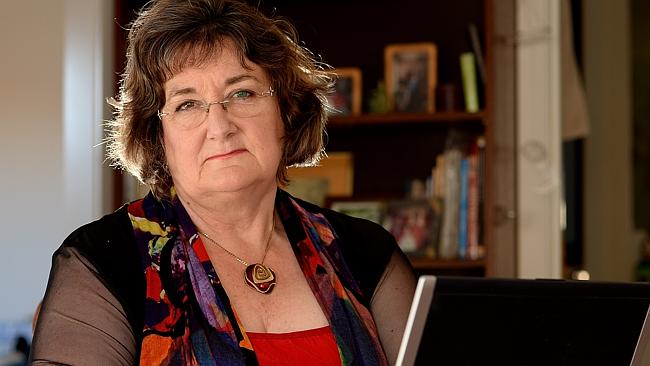
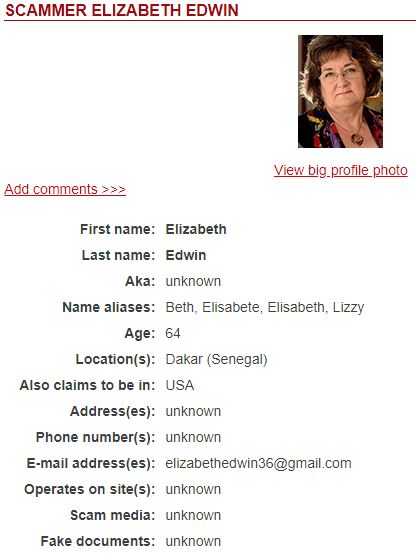
Yesterday I received an email from a person on my mailing list with a message saying they had found my photo in a scammers profile.  Oh what joy!  My picture on a scam site under the name of Elizabeth Edwin.

(See Updates  for this mystery at the bottom of this post)

This notification led me on a voyage of discovery as I followed the mystery down a number of paths.

Firstly I contacted the site for female fake profiles –  https://www.stop-scammers.com/ to let them know that the photo was of me.  It was a photo taken of me by the Herald Sun in July 2015 that I also use on my Media Presence page. I received an automated email back, but it will be interesting to see what they say about this.  Names of the real people behind the photos is not divulged on the site that I could see.  This site has thousands of stolen photos and fake profiles with other supporting information about scammer activity.  I only used the free service, which is a bit limited, but it looks like a comprehensive site. Continue reading A stolen photo mystery

Award winning research – Prevention messages need review

Cassandra Cross, The QUT cyber fraud and scam researcher, claims putting out warnings about all the different types and plots of scams does not effectively deliver warnings that help people avoid scams, especially romance scams.  The focus needs to change so effective, consistent and repeatable warnings are given, and the ongoing losses are stopped. She has been in the news again winning awards for her article about this, as well as being quoted in the press, doing a TED talk, attending local and overseas conferences, and having her (co-authored) book published.

Highly Commended Award celebrates unique insights into what prevention strategies work.

The Emerald Literati Awards celebrate and reward the outstanding contributions of authors and reviewers to scholarly research. Her article with fellow (Toronto Police Service) author Michael Kelly The Problems of “white noise”: examining current prevention approaches to online fraud  received the Highly Commended award for the Journal of Financial Crime. Continue reading Award winning research – Prevention messages need review

Western Union admits that its system facilitated scammers

Western Union (USA) admits that its system facilitated scammers, and puts money aside to recompense victims. What does this mean for us in Australia? How can you see details of your financial transactions?

In a media release from the Federal Trade Commission (USA) posted on 19 January 2017, it was announced that not only did Western Union admit its culpability in “willfully failing to maintain an effective anti-money laundering program and aiding and abetting wire fraud” but also that it has forfeited $586 million so it can recompense victims of these frauds.

Whilst the cited cases are based around sending money to China for people or drug trafficking, and aiding and abetting offshore gambling, the terms of the overall judgement, taken jointly by a large number of US agencies, are much more general than just this.  The problems with Western Union, according to them included: Continue reading Western Union admits that its system facilitated scammers

Different types of romance scams

The more contacts I have from people who have been scammed the more I see the different types of scams that are being carried out.  The amount of ‘romance’ can vary.  There are a number of types of activities that have building a relationship as a primary focus.  You will find these listed on the governmental sites that talk about scams as Online Scams or Fraud, and this is a more generic description. Only when you read the detail does it make it clear this relates to what is commonly known as ‘romance’ or ‘dating’ scams.

In my blog I have focused on scams that use romance as the hook to then enable the scammer to exhort money.  The contact mechanism is often dating sites, but can also be any membership site or social media such as Facebook or even communication mechanisms such as Skype or Viber. Whilst dating sites have the benefit (to the scammer) of legitimacy and expectation of making contact, because that is the purpose of the site, other mechanisms, like on Facebook, the scammer is putting out a ‘cold’ request for contact with no automatic expectation, except social convention and politeness perhaps, of a response.  They must be successful though, because they keep doing it, and I know from victims who respond thinking “its just friendship, it can’t hurt”, that whatever lure they are using, it works. Continue reading Different types of romance scams

Police are not doing enough about scams!

Australians lose millions of dollars through romance scams and there is no evidence that police are doing anything. Here are the responses to my queries to the relevant agencies.  Victims want justice, the police don’t seem to be taking any notice.  This is not good enough!

My last blog questioning what the police are doing to investigate scams has generated some interesting responses. A promise for more information from a senior member of the Victorian police; a response from the ACCC to my query; and someone’s FOI request has given a standard response from the Australian Institute of Criminology (ACIC).  Since July the ACIC has had responsibility for ACORN. Continue reading Police are not doing enough about scams!

What are our police forces doing about romance scammers??

When someone contacts me saying they have been scammed and what should they do one of my first suggestions to them is to report the scam to ACORN (Australian Cybercrime Online Reporting Network).  I am an Ambassador for them, so that’s logical, right?  But what does ACORN do?

I was recently contacted by someone in this situation, and her story, is, according to the research by Cassandra Cross mentioned in my last post, not that unusual.  She communicated with me over a number of days, complaining that no-one in the various police forces would take her call, and that she was continually referred on to someone else, who then referred her on again.  This included state police, federal police, and even Interpol, who could work on her behalf, but only if contacted by the relevant local agency (police).  But they weren’t interested in even taking her details. Continue reading What are our police forces doing about romance scammers??

Cyber Love’s Illusions

The definitive text  on healing from being scammed is Cyber Love’s Illusions – The Healing Journey – Recovering from a Romance Scam, by Anna Alden Tirrill and Jon van Helsing. Here I review the first section on the emotional aftermath of the scam and letting go.

—-      —-

Cyber Love's Illusions Book Cover
Cyber Love’s Illusions Book Cover

I have talked about various aspects of healing journey after being scammed in my posts here, mostly from my own experience.  The definitive text is Cyber Love’s Illusions – The Healing Journey – Recovering from a Romance Scam, by Anna Alden Tirrill and Jon van Helsing. This is the companion book to Cyber Love’s Illusions: Anatomy of a Romance Scam.  I have wanted to have these books for some time, but have not had the money to pay for them and shipping to Australia. A dear friend has gifted them to me, but only the first has arrived so far. Both books have at their core the information and experience gathered from the Yahoo group Romancescams run by the experienced team from www.rormancescams.org . They have supported tens of thousands of romance scam support group members and millions of visitors to their site.

I was pleased to see that the ‘Healing Journey’ book addresses the emotional aftermath of being scammed in one section and the practical and legal aftermath in another. I have made similar distinctions through my blog. So far, I have only read the first section, and plan to write my next blog on part two.

The first chapter helps readers identify if you have been scammed.  There is a quiz, with 18 Yes/No questions.  Three or more YES answers leads you to consider red flags to see if they apply including:

  • 9 characteristics or behaviours of scammers on first contact
  • 22 typical characteristics of their communication skills
  • 21 habits that define them
  • 3 inconsistencies noticed about scammers

If you have identified that you have been scammed from this, there are 7 things you should do, including an additional set of six activities to prove to yourself that the person is not who they say they are, provided by a Nigerian “deep throat”. A number of different scam scenarios are shared, as well as examples of types of photos used by scammers, actual IM conversations, and a fake passport.  Its all very comprehensive so if you have had any doubts before now, if any of these apply to you there will be no lingering doubts. There is also a space at the end of each chapter to write down your own thoughts about information covered in the chapter.

Through the next chapters the difficulties of letting go of the fantasy relationship set up by the scammer are covered, including the similarities with Battered Women’s Syndrome, and the stages these women go through. To quote:

“In extreme cases of victimization, as with domestic abuse, the overriding emotions included: learned helplessness, loss of self-esteem, self-blame, anxiety, depression, fear, suspiciousness, loss of belief in the possibility of change, and the tendency to use self-destructive methods of coping with fear and stress, like food, drug or alcohol abuse. Battered Women’s Syndrome (BWS) is recognised in the Diagnostic and Statistical Manual (DSM) as a formal clinical syndrome within Post-Traumatic Stress Disorder (PTSD).”

And, when the eventual awakening  to the scam happens,

“This awakening brings with it the emotional devastation, not only of a broken heart, but diminished self-image, demolished self-confidence, and the inability to trust oneself, one’s judgement, one’s feelings and ultimately, other people.”

I recently received feedback that at a particular outing, one of the other people there found me ‘unfriendly’. I realised that it was exactly this state of being described in this quote applying in my life.  I could not put myself out there to be friendly because at that time I did not value myself as someone worth knowing.

Illusions of Love, by Kalolaina

The feeling of being emotionally raped and the stages of Rape Trauma Syndrome as it applies to romance scams are explored. There are quotes from victims of the difficulties they have in letting go of the fairy tale romance, the dream that has been built by the scammer, and the grief and loss that is experienced. The way I got through this was to go to www.romancescam.com and read the postings there of interactions of others with scammers.  I soon saw that the scenarios were the same, the text was often the same, and sometimes the names are the same.  The name of the daughter in my scam was Patience Blessing ( I just searched on the name Patience and found this). I found a scenario VERY similar to mine where the daughter was called Blessing Patience.  By doing all this research I was able to see that the scam was NOT PERSONAL.  It was not about me as a person at all.  It was all about the money I could provide.  Doing this enabled me to let go of the idea that there was a person there that loved me.  I realised it was all just an act.

The difficult topic of cyber-love is explored, including how people are lured by wanting “to know they are desirable, special, wanted, loved and cherished”, into disrobing in front of a webcam.  Whilst they think they are doing this in the privacy of their own home with the partner that they love, will marry, and who is caressing them with loving words in a seemingly mutual engagement, in reality they are doing this on a webcam beaming to a cyber-café, somewhere in Nigeria most likely, with men standing around ogling at them and laughing at them.  The importance of this event in the mind of the victim cannot be underestimated however, as it signifies and further inflates a deep level of intimacy, that is a further manipulation of the victim into being emotionally likely to send money.

“Because the scammer uses this perceived intimacy to make inroads into the victim’s mind, emotions and will, he can often totally disengage the victim’s normal reasoning ability and her (or his) sense of discernment and judgement”.

This is a key ingredient in “taking the brain” that I talk about in a previous blogbrainI know the power of this intimacy from personal experience. I had not realised it was actually abuse until I read this in the Scams of the Heart Blog.  I held on to a comment made by my scammer that he was “surprised that he found himself attracted to my body type” as an indication that he was really attracted to me way beyond the time when I let go of other beliefs that the scam had been real.  Luckily for me I was not subject to a further blackmail scam with threats to make my ‘webcam’ activity public, but I do know of others who have received this threat.


Though its not the last chapter in this section on the emotional impacts, I will close this blog with this further quote from this great book which echoes my last post on the Right of Reply:

“Above all else, victims need to understand that they DID NOTHING WRONG!  They were being a loving, compassionate and caring person.  They’re not stupid and they’re not to blame.  They don’t need to put themselves down or let anyone else judge or criticise them.”

More on the book in my next blog.

Anna Alden Tirrill and Jon van Helsing, Cyber Love’s Illusions – The Healing Journey – Recovering from a Romance Scam, 2010 Published by White Cottage Publishing Company. 
http://www.cyberlovesillusions.com/
This is the companion book to Cyber Love’s Illusions: Anatomy of a Romance Scam.

I think my friend is being scammed…

I was contacted recently by a woman who was concerned for her friend and wanted some urgent advice.  “I have been listening to a friend’s beautiful love story unfolding, and then realised where it was heading”, she said.  She had seen the same pattern previously herself but had pulled out.  She had found my blog and got in touch. She acknowledged that “Although we are both intelligent women our need to be loved, and love, is stronger than reason, as you know”.  Yes, I know this only too well and at a high cost.

I had already been thinking about this question, and had even drafted a book outline on the topic.  I had been warned by friends, but disregarded the warnings, and have ‘kicked myself’ since.  So here are a few pointers to help, from the perspective of being a friend. (Remember that men can also be scammed by women, its not allways this way around.)

Understand how scams/scammers work

It important that you understand how scammers work so you can understand what is happening to your friend.

  1. The scammer has gathered information on your friend, and knows their weak points, and how much they want to be loved.  They will have no qualms about using this against your friend to their monetary advantage.
  2. friendsThe scammer will profess love quickly and deeply, making it seemed destined, special, magical, and its natural for anyone wanting love to respond to this. Though the text of emails, messages, chats are tried and tested pro-forma materials, they will seem genuine, personal and include promises of forever love. Your friend may at this stage be sharing with you the excitement of finally found their one true love.
  3. When ‘in love’, the hormone oxytocin is engaged, and this heightens trust, so the friend will be more trusting of the scammer than they might otherwise be. This means that they will be more likely to not focus on the inconsistencies in the experience, passing them by.
  4. They will be communicating at all hours, especially through the night, keeping your friend sleep deprived.  This makes it more difficult for your friend to make rational decisions when the scammer eventually  asks for money.  The scammer may also provide legitimate looking documents as evidence of their credibility or financial capacity to repay money.
  5. When confronted about being a scammer, the scammer will respond with righteous anger, feigning affront, and will encourage the friend to cut off from others, especially those with warnings.
    heartThe scammer will say that “what we have is special” and “they would not understand so don’t bother trying to explain – they will understand when they see us together – don’t talk to them”.  They will not ever intend to be together, but they will profess and promise otherwise.  The scammer will encourage your friend to cut off from you and other friends or family.  This may mean they will try and push you away or cut off from you.
  6. A high level of intimacy will be developed, including possible connections to others in the scammer’s imaginary family, including children.  This adds an element of normality and family intimacy which counters the sense that it might be a scam.
  7. They ask for honesty and make lots of promises (but will never return them).

As a friend of someone being targeted for a scam

  1. Keep close contact with your friend and resist being pushed away.  Encourage them to keep sharing with you.  You may want to just cry out “Stop it” but this might push them away from you and its important to keep the communication open.
  2. Be respectful of what your friend is feeling, however try to keep them open the equal possibility that it is a scam.
  3. chanakya-politician-the-earth-is-supported-by-the-power-of-truth-itIf you can, get actual emails and photos of the scammer.  Use these to do some checking using some of the sites such as romancescam.com, and scamsurvivors.com to check for previously stolen photos and search for stand-out segments of text.  As the same ones are used frequently, you may find them already reported, giving you information to take to your friend as evidence of a suspected scam.  Also do a Google image search on the photo: you are looking for the photo being connected to other names than the one used by the scammer.  Make sure you check on all results pages, and check for any google messages saying there is more to be seen, checking these results as well.  If you have the technical ability you can check the IP address in the email header as well to see if it is coming from the same location as the scammer.
  4. If you do find evidence that it may be a scam, present it as another possibility, not “the truth”, and encourage your friend to look further for themselves. Be careful not to make them wrong or unworthy of love.  When this happened to me I became rebellious, insisting that I deserved to be loved, and it pushed me further towards the scammer.
  5. Scams of the Heart link
    Scams of the Heart Blog link

    Here are some what not to say and why tips from by Soraya Grant in her Scams of the Heart blog.  This blog is excellent, and well worth a read in more detail.

  6. The person who contacted me made a great point about the need for a friend to match the time and energy level of the scammer, and identified the “need to apply just as much bombardment of information and support, even when it feels like intruding”.  She specifically judged when her friend could take in and be receptive to certain pieces of information. It takes a great friend to do this – I commend her on her efforts.
  7. If you are not sure what to do, reach out, to me or some of the other sites offering support resources.  There is help out there.  See my Support for Victims of Scams page.
  8. If your friend does part with money, and then realises they have been scammed, encourage them to report it.  See my blog on this.

Luckily in this instance we can report a good outcome.  Contact was broken off with the scammer, and life has moved on.

One last thing.. be wary about secondary scams.  Once they are in contact they may try again.  This includes, for example, scammers pretending to be police or Interpol, saying they have your money, or your scammer, including providing forged documents about this.  Don’t be tempted to go there, its another scam. More on this in my next blog.